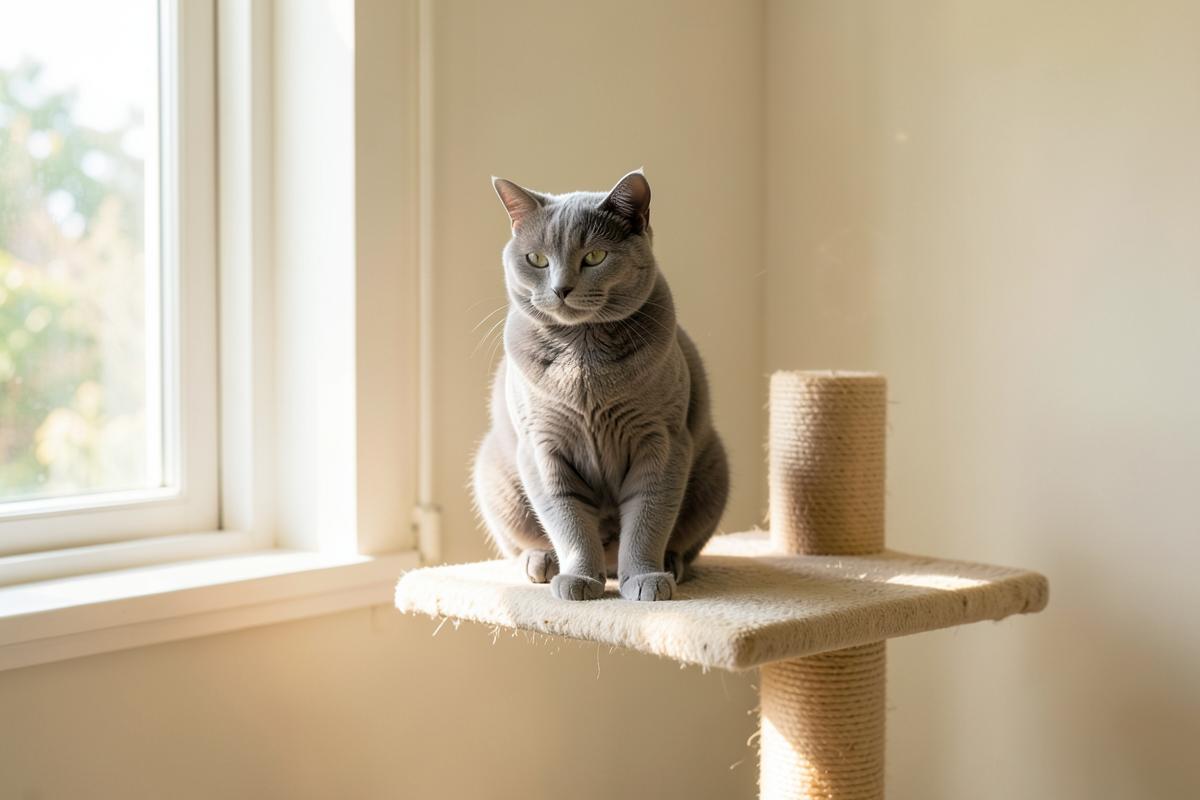
Indoor Cat Basics
How to Keep an Indoor Cat Happy and Stimulated
A good indoor life gives cats ways to climb, hide, scratch, stalk, chase, explore, eat and watch—not simply a larger pile of toys.
10 min read
Your cat sleeps on the couch.
Moves to the window.
Sleeps there.
Gets up, eats something, stares into another room for reasons known only to them, and goes back to sleep.
Bored?
Maybe.
Or you may simply own a cat.
One of the problems with trying to spot boredom in cats is that there isn't a single behavior that proves it. Cats naturally spend a lot of time sleeping and resting. They also scratch, climb, chase things, yell at us and occasionally sprint through the house like they've received terrible news.
Those things aren't automatically signs that something is wrong.
A better clue is pattern.
If your indoor cat has very few opportunities to hunt, play, climb, explore or work for anything—and they regularly seem to be inventing their own ways to fill that gap—more stimulation may be exactly what they need.
Here's what that can actually look like.
Cats sleep a lot.
A cat spending a large part of the day asleep is not, by itself, evidence that your home has become emotionally unbearable.
The more useful question is what happens when they're awake.
Does your cat still show interest in food, play, windows, people, exploration and the normal activities they've always enjoyed?
Or has something changed?
A cat who has always been an enthusiastic professional sleeper may simply be continuing a successful career.
A cat who suddenly becomes much less active, stops playing or withdraws from normal routines deserves more attention.
Boredom is about the overall pattern, not the existence of naps.
Cats are excellent at creating projects when none have been assigned.
Sometimes those projects involve opening cabinets.
Sometimes they involve knocking objects off shelves one at a time.
Sometimes the toilet paper has apparently offended them personally.
Chewing, climbing where they never used to climb, repeatedly disturbing objects or obsessively investigating the same forbidden area can all happen when a cat has energy or curiosity with nowhere particularly useful to put it.
That doesn't mean every knocked-over cup is a cry for enrichment.
Cats knock things over because they are cats.
But if your cat's day offers very little to chase, climb, scratch, explore or solve, and the household is becoming their personal escape room, giving them better options may help.
Our guide How to Keep an Indoor Cat Happy and Stimulated covers the bigger environmental picture.
An indoor cat still has predatory behavior even if their dinner arrives in a bowl.
If there isn't much appropriate hunting-style play in the day, moving human feet can become extremely convenient prey.
A surprise ankle attack does not automatically mean your cat is bored, and playful ambushing can be completely normal.
But repeated rough pouncing, grabbing or chasing of hands and feet—especially in a young or energetic cat with very little interactive play—can be a clue that the hunting machinery needs somewhere better to go.
Use toys rather than your body.
Wand toys are particularly useful because they let the cat stalk, chase and catch something without teaching them that exposed human skin is today's entertainment.
If you're trying to build a practical play routine, How Much Exercise Does an Indoor Cat Need? gives you a starting point.
Some cats are naturally talkative, social and deeply committed to supervising their humans.
That isn't boredom.
But there is a difference between a cat who likes interaction and one who seems unable to find anything else worth doing.
Maybe every time you sit down, the cat starts yelling.
You get up.
They walk away.
You return to your chair.
The emergency has somehow resumed.
Attention-seeking can become one of the easiest available activities when the rest of the day is extremely predictable.
Before deciding your cat is simply being demanding, look at what else the environment offers.
Is there somewhere high to sit?
Anything worth watching?
Regular interactive play?
Something appropriate to scratch?
A meal that occasionally requires more effort than leaning over a bowl?
If the answer to most of those is no, the cat may not be asking for your attention because you're uniquely fascinating.
You may simply be the only thing in the room that changes.
Food should be interesting.
The problem is when it becomes the entire entertainment schedule.
A cat who spends large parts of the day following people into the kitchen, checking an empty bowl, yelling near the food cabinet or trying to negotiate additional meals may simply be food-motivated.
But in a quiet indoor environment, eating can also become something to do.
Before adding calories, try adding feeding opportunities in a different form.
Divide the same daily amount into smaller meals.
Put part of the ration in an easy puzzle feeder.
Hide a few pieces of dry food somewhere simple.
Let the cat search.
That turns some of the day's food into activity without quietly converting enrichment into weight gain.
Understimulation does not always look like destruction.
Sometimes it looks like very little happening at all.
A cat may stop showing much interest in toys that are always available, spend most waking hours in one or two locations and rarely seem to investigate anything.
That may mean the environment needs more variety.
It may also simply be that the cat is calm, comfortable and not especially theatrical.
Again, change matters.
If your cat has always been relaxed and low-energy, that's different from a cat who used to play, explore and interact and has gradually stopped doing those things.
And sudden withdrawal, lethargy or loss of interest should not be filed under boredom before medical causes have been considered.
| Behavior | Could Be Completely Normal | More Worth Investigating |
|---|---|---|
| Sleeping much of the day | Your cat has always had this routine and is active when awake | Noticeable increase in sleeping or loss of normal activity |
| Scratching furniture | No suitable scratcher nearby or cat prefers that material/location | Repetitive destructive behavior alongside few other outlets |
| Pouncing on feet | Occasional playful ambush | Frequent rough attacks with little appropriate interactive play |
| Meowing for attention | Normal social behavior | Constant demands when the cat otherwise has very little stimulation |
| Ignoring toys | Doesn't like that particular toy | Stops engaging with toys or activities they previously loved |
| Zooming around the house | Normal bursts of feline activity | Constant restless behavior combined with few play opportunities |
No row in that table diagnoses boredom on its own.
You're looking for context.
What is normal for this cat?
What opportunities do they have?
What changed?
If you think your cat needs more stimulation, you don't need to arrive home with fourteen new products.
Change the day first.
Try a short interactive play session in the morning and another when your cat naturally becomes active later.
Put half the toys away and rotate them rather than leaving everything available forever.
Move a cardboard box somewhere new.
Add a stable perch near a safe window.
Give the cat an appropriate scratching surface where they already want to scratch.
Use part of the normal food ration in a puzzle or simple food-searching game.
If you want the broader setup, read How to Keep an Indoor Cat Happy and Stimulated.
And if toys are clearly the missing piece, Best Toys for Indoor Cats compares several different play styles rather than assuming every cat wants the same plastic mouse.
The goal is not maximum stuff.
It's giving normal feline behavior somewhere appropriate to go.
Then watch which changes your cat actually uses.
A sudden behavior change deserves more caution.
Do not assume a cat simply needs more entertainment if your cat:
Those changes can have behavioral or medical causes that need more than a new toy.
A cardboard box is powerful. It is not a diagnostic instrument.
A bored indoor cat doesn't come with a flashing NEEDS MORE ENRICHMENT warning light.
You have to look at the whole cat.
Sleeping is normal. Scratching is normal. Running around the house like a maniac can be normal.
What makes understimulation more likely is a pattern: your cat has very few appropriate outlets for normal feline behavior and repeatedly seems to invent their own—or disengages from a day that doesn't give them much to engage with.
Start by improving the environment rather than buying everything with a cat printed on the package.
Play together. Rotate toys. Give food something to do besides sit in a bowl. Provide places to climb, scratch, hide and watch the world.
Then pay attention to which changes your cat actually responds to.
Because boredom looks different from one cat to another.
And your Urban Feline, despite refusing to complete the customer satisfaction survey, is still the best source of feedback you've got.
We research, write and update every guide on this site. Our articles are general educational information for cat owners and are reviewed against current guidance from veterinary and feline welfare organisations. Read our editorial policy.
A good indoor life gives cats ways to climb, hide, scratch, stalk, chase, explore, eat and watch—not simply a larger pile of toys.
10 min read
Two or three short play sessions a day is a useful adult-cat starting point, but the right routine depends on the cat rather than the stopwatch.
10 min read
Five useful cat toys covering interactive hunting, budget play, solo batting, catnip kicking and electronic movement—without pretending every cat likes the same thing.
12 min read
Get practical indoor-cat tips, helpful guides, and product recommendations delivered to your inbox.
A short email now and then. Unsubscribe any time.