Indoor Cat Basics
How to Keep an Indoor Cat Happy and Stimulated
A good indoor life gives cats ways to climb, hide, scratch, stalk, chase, explore, eat and watch—not simply a larger pile of toys.
10 min read
Some cats will chase a wand toy until your shoulder files a workplace complaint. Others make three heroic pounces, sit down, wash one leg and act as though the activity portion of the evening has concluded. Both can be completely normal.
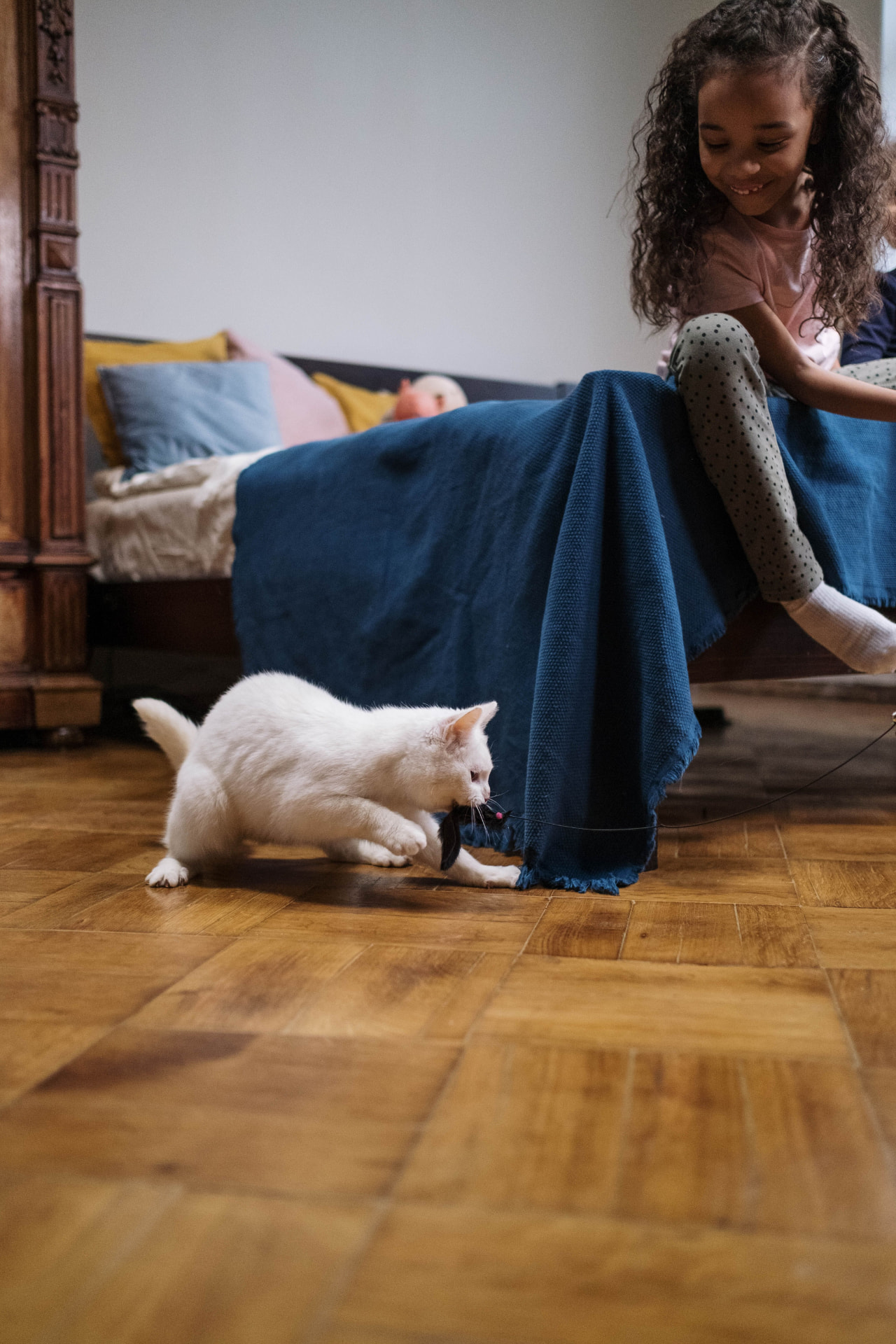
So how much should you actually play with an indoor cat?
For a healthy adult cat, two or three short interactive play sessions a day, somewhere around 10 to 15 minutes each, is a useful starting point.
Not a law.
Not a timer you need to reset because your cat walked away at minute seven.
Some cats want more. Some are satisfied with less. Kittens can seemingly generate electricity from nowhere, while an older cat may prefer a five-minute stalk-and-pounce session without leaving the rug.
The better goal is regular opportunities to play, adjusted to the cat standing in front of you.
You don't need to entertain your cat for an uninterrupted hour every evening.
In fact, many cats wouldn't cooperate even if you tried.
Cat play tends to happen in bursts. A cat may become intensely focused on a toy, stalk it, chase it several times and then suddenly decide that whatever is happening in the kitchen deserves immediate investigation.
That short attention span doesn't necessarily mean the cat dislikes playing.
Veterinary guidance generally favors several shorter interactive sessions rather than trying to force one long workout. For many adult cats, ten or fifteen minutes at a time is plenty.
And even that number should be flexible.
If your cat is deeply engaged after fifteen minutes, you don't need to announce that today's federally permitted play period has expired.
If they've genuinely had enough after eight minutes, dragging a feather around for another seven isn't accomplishing much either.
Watch the cat, not the stopwatch.
Timing makes a bigger difference than people realize.
You can own the world's greatest cat toy and still get absolutely nowhere if you present it while your cat is four naps deep into the afternoon.
Cats often become more active around morning and evening, which makes those convenient times to try interactive play.
Your own cat may have an even more obvious schedule.
Maybe the nightly zoomies happen at 9:30.
Maybe you can't make coffee without being ambushed.
Maybe every evening your cat suddenly begins sprinting from the bedroom to the hallway and back for no apparent reason.
That's useful information.
Instead of trying to manufacture energy at a random time, put a play session where that energy already exists.
A morning session and another in the evening is a very reasonable place to start. A particularly active cat might enjoy a third somewhere in between.
Cats don't normally hunt by having prey repeatedly smacked into their forehead.
Keep that in mind when using a wand toy.
Move the toy away from your cat rather than constantly pushing it toward them. Let it dart around a chair leg. Make it disappear behind the couch. Pause.
Then move again.
Some cats prefer a toy skittering along the floor like a mouse. Others go nuts for something fluttering through the air. Some cats seem to require a full three-minute surveillance operation before deciding the target deserves to die.
Let them do that.
Stalking is part of the game.
So are chasing, pouncing, grabbing and biting.
Feline behavior guidance consistently treats these predatory-style movements as normal components of play, which is why interactive toys work so well as an outlet for indoor cats.
You aren't just trying to make your cat run.
You're giving normal hunting behavior somewhere appropriate to go. If you want ideas for what to buy, Best Toys for Indoor Cats compares several genuinely useful options.
Imagine playing a game where you're allowed to chase the ball but physically incapable of ever touching it.
That would get old.
Your cat needs some wins too.
When you're playing with a wand or similar interactive toy, let the cat successfully pounce on and grab it throughout the session. Feline behavior guidance recommends giving cats opportunities to capture their pretend prey rather than creating an endless chase with no payoff.
This is also worth remembering if you use a laser pointer.
The moving dot can trigger plenty of chasing, but the cat can't actually grab a dot of light. If you use one, transition the game onto something physical the cat can capture rather than making the entire experience an unwinnable red-dot conspiracy.
Toward the end of a session, slow things down.
Let the cat make a final catch.
Then put the wand away.
You do not need a tiny awards ceremony afterward.
Because cats are cats.
Seriously.
Short play does not automatically mean failed play.
Cats vary enormously in play drive, and they can also lose interest quickly when a toy stays predictable.
That's why rotating toys works better than leaving thirty of them permanently spread across the floor.
Put some away.
Bring them back later.
Even the way you move the same toy can matter. A feather wand dragged slowly underneath a blanket is a different experience from the same wand bouncing around in the air.
You also don't need expensive equipment.
Simple things like boxes, balls and other safe household-style toys can provide perfectly good play and enrichment.
Your cat remains completely unaware of MSRP.
A kitten can make two or three adult play sessions look laughably inadequate.
Young cats usually have a much stronger play drive and may want numerous brief sessions throughout the day. Chasing, wrestling, pouncing, grabbing and biting are all part of normal kitten play.
This is also when it's especially important not to teach them that human fingers are prey.
It's cute when a tiny kitten grabs your hand.
Less charming when the tiny kitten becomes a twelve-pound adult who has spent a year perfecting the technique.
Use wand toys, tossed toys and other objects that put some distance between claws and human skin.
Teach the game you want the adult cat to keep playing.
Senior doesn't mean retired.
An older cat may not launch four feet into the air anymore, but play can still provide movement, mental stimulation and positive interaction.
The style may simply need to change.
Try slower toys closer to the floor. Give the cat longer opportunities to stalk before asking them to chase. Keep sessions shorter if that's what they prefer.
An older cat with arthritis or another physical limitation shouldn't be pushed into athletic movements that are uncomfortable.
And if a cat who normally enjoys playing suddenly stops altogether, pay attention.
The significant part isn't necessarily how many minutes they played.
It's that something changed.
Pain and illness can affect activity, particularly in older cats, and a noticeable loss of interest in normal activities deserves more attention than simply assuming the cat has become lazy.
Yes.
Just not in exactly the same way.
If your cat spends twenty minutes batting a ball down the hallway, wrestling a kick toy or throwing a toy mouse into the air, that's genuine activity and enrichment.
Great.
Encourage it.
But interactive play gives you control over movement in ways a stationary toy can't. You can make a wand disappear, escape, stop, hide and suddenly move again.
That's much closer to an unpredictable prey sequence.
Interactive play also gives you time directly engaged with your cat, which is useful on its own.
The two forms aren't competitors.
Your cat can have independent toys available and still get short sessions of interactive play with you.
If you want to look beyond play and improve the entire environment, How to Keep an Indoor Cat Happy and Stimulated covers climbing, scratching, food enrichment, hiding spaces and the rest of the picture.
Play is important.
It isn't the whole indoor life.
There isn't a playtime dashboard hiding underneath your cat.
You're looking for the overall pattern.
A cat getting appropriate outlets should have regular opportunities to chase, stalk, pounce and interact without having to turn your ankles into the primary recreational facility.
That doesn't mean a well-enriched cat never gets zoomies, scratches the wrong object or wakes up feeling chaotic.
Cats do those things.
Instead, ask whether your cat regularly engages when offered appropriate play and seems satisfied with the routine afterward.
If your cat constantly appears to be searching for something to do, aggressively attacks moving feet, demands interaction all evening or repeatedly invents destructive projects, additional or better-quality play may help. Our guide How to Tell If Your Indoor Cat Is Bored goes deeper into that distinction, including why individual behaviors aren't enough to diagnose boredom on their own.
This may be the easiest mistake to make.
You read that cats need play.
Now you've decided there will be exactly thirty minutes of Mandatory Feline Exercise every day at 6:15 p.m.
Your cat has not agreed to this program.
Start simpler.
Try ten minutes in the morning.
Try another short session when your cat becomes active in the evening.
See whether they want more.
Change the toy if they aren't interested. Change how you move it. Try floor prey instead of flying prey. Put old toys away for a while and bring them back later.
A good play routine adapts to the cat rather than forcing the cat to adapt to the spreadsheet.
Consistency matters.
Precision doesn't.
For many healthy adult indoor cats, two or three short interactive play sessions of roughly 10 to 15 minutes each per day is a solid starting point.
Your cat may need more or less.
Kittens usually want more opportunities. Seniors may prefer gentler and shorter sessions. High-energy cats can make the recommended starting point look like a warm-up.
Focus less on hitting an exact number and more on giving your cat regular chances to behave like a cat.
Let them stalk.
Let them chase.
Let them catch something.
Then watch what happens.
If your Urban Feline disappears halfway through the session because they remembered a cardboard box exists in the other room, don't take it personally.
Apparently the box had an appointment.
We research, write and update every guide on this site. Our articles are general educational information for cat owners and are reviewed against current guidance from veterinary and feline welfare organisations. Read our editorial policy.
A good indoor life gives cats ways to climb, hide, scratch, stalk, chase, explore, eat and watch—not simply a larger pile of toys.
10 min read
Boredom isn't one symptom. Look for patterns, changes, and whether your cat has useful outlets for normal feline behavior.
10 min read
Five useful cat toys covering interactive hunting, budget play, solo batting, catnip kicking and electronic movement—without pretending every cat likes the same thing.
12 min read
Get practical indoor-cat tips, helpful guides, and product recommendations delivered to your inbox.
A short email now and then. Unsubscribe any time.