Cat Products
Best Cat Trees for Indoor Cats
Four cat trees compared on the things that matter after assembly: stability, usable perch space, scratching surfaces, construction, repairability and price.
11 min read
You bought the cat tree.
You assembled the cat tree.
You found the one mystery bolt that somehow remained after assembly and decided not to think about it too hard.
Then your cat ignored the entire thing.
Before blaming the cat tree, look at where you put it.
The best place for a cat tree is usually somewhere your cat already wants to spend time, where the tree gives them something useful: height, a view, scratching space, a comfortable resting spot, proximity to you, or somewhere to step away from activity.
That might be beside a living-room window.
It might be in your office.
It might be in the bedroom.
There isn't one correct room for every cat.
The theoretically perfect cat-tree location means very little if your actual cat never goes there.
Before moving furniture, watch your cat for a couple of days.
Where do they nap?
Where do they sit when you're watching television?
Where do they watch you cook or work?
Which window do they already visit?
Where are they scratching?
Those habits give you a much better starting point than a generic rule about where cat furniture belongs.
Feline environmental guidance recommends providing cats with climbing and elevated areas while also locating important environmental resources in places that make sense to the individual cat. Scratching surfaces in particular should be distributed through the home and placed where cats actually spend time.
So if your cat spends every evening in the living room with you, placing the tree in a back bedroom because it matches the curtains better may be a poor trade.
Your interior design has been noted.
The cat has overruled it.
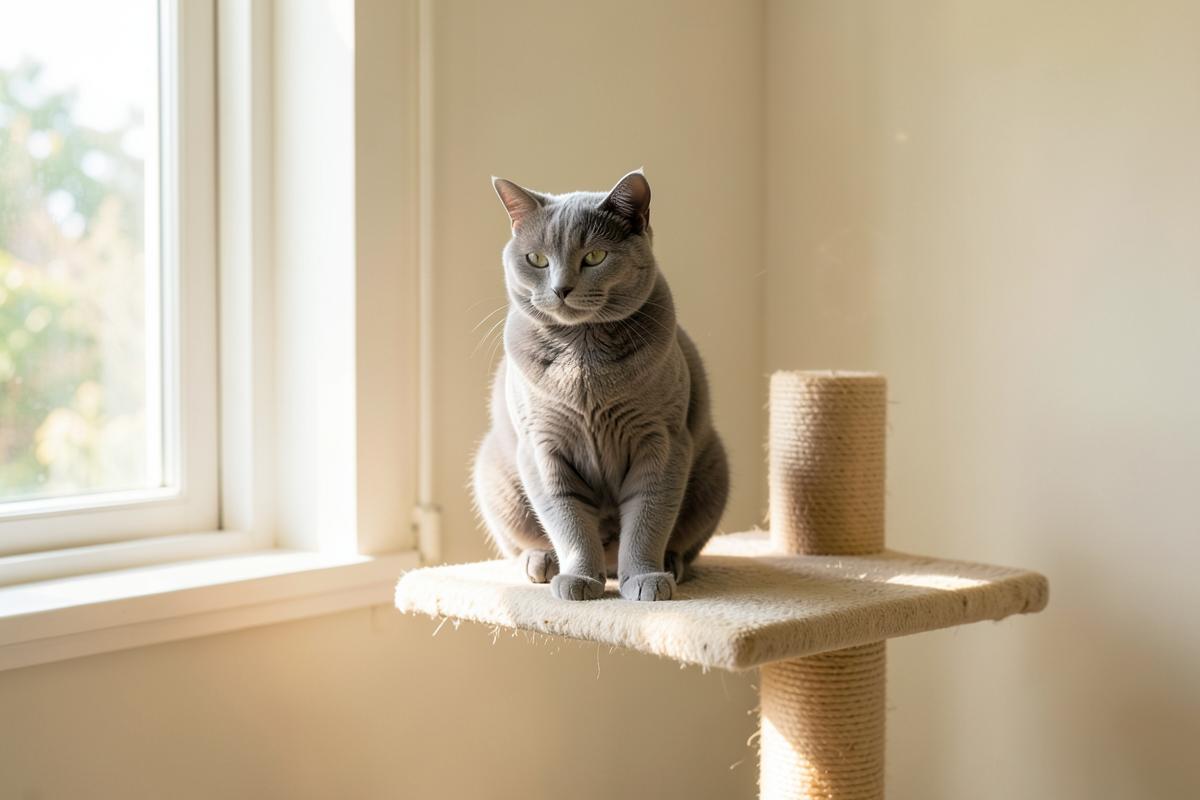
There's a reason cat trees so often end up beside windows.
Height plus an outdoor view can turn one piece of furniture into a resting place, observation tower and entertainment system.
Window views and elevated areas can be useful forms of indoor enrichment, and sunny windows can make appealing warm perches.
So yes—a secure window in a room your cat already enjoys is one of the first places I'd test.
But “always put the cat tree by a window” is too simplistic.
Some window views are not relaxing.
If neighborhood cats regularly walk through your yard, an indoor cat may stare, become agitated, pace, vocalize or become intensely aroused because they can see another cat they cannot reach.
Watch the cat instead of assuming the view is enrichment.
Birds outside?
Excellent television.
Neighborhood cat making sustained eye contact from six feet away while your cat's tail doubles in size?
Different channel.
If outdoor cats are causing problems, visual barriers such as privacy film can be one management option.
And make the window itself safe. Open windows, balconies, insecure screens and dangling blind or curtain cords can all create hazards.
Instead of asking, “Which room should the tree go in?”
Ask:
What do I want this tree to do for my cat?
If your cat wants to stay near you but doesn't necessarily want to sit on you, a perch near the living room or home office can give them a place to participate from a safe distance.
If they like watching outside, use the window.
If they constantly scratch one side of the sofa, a tree with good scratching surfaces near that location may give them a better option.
If your cat regularly retreats when the house becomes busy, the better location may be somewhere calmer where they can observe without constantly having feet, children or other animals passing underneath them.
The same cat tree can do very different jobs depending on where you put it.
Things get more interesting when several cats share the house.
You could buy an enormous tree with seven platforms and still create a problem if all of the household's desirable elevated territory exists in one location.
Cats don't necessarily view seven platforms attached to the same structure as seven completely separate resources.
Current feline environmental guidance recommends multiple, separated resources so cats can access resting spaces, scratching areas and other important parts of their environment without being challenged or blocked by another cat.
Watch for subtle signs.
One cat may always occupy the highest bed.
Another may wait until that cat leaves before approaching.
A cat may stare from the floor but never climb when another cat is already on the structure.
Blocking and prolonged staring can be signs of possible intercat tension.
That doesn't automatically mean your cats are fighting.
It may simply mean you need another desirable elevated option somewhere else.
Sometimes two modest perches in different parts of the home are more useful than one magnificent feline apartment complex.
There's an understandable human instinct to organize all cat belongings together.
Cat tree.
Food.
Water.
Litter box.
Toy basket.
Perfect.
Everything feline has now been contained in one convenient six-foot area.
Your cat did not request this efficiency initiative.
Feline environmental guidance recommends separating key resources such as food, water, toileting, scratching and resting areas rather than concentrating everything together. This becomes especially important when several cats share a home because separation reduces opportunities for one cat to block another's access.
So don't choose the tree location merely because “that's where the cat stuff goes.”
Let it become useful territory somewhere else in the home.
A fantastic location cannot rescue a tree that moves every time your cat jumps onto it.
Scratching and climbing structures need to be sturdy enough that they won't topple during use.
Put the tree on a level, stable surface.
Use any manufacturer-provided wall restraint or anchoring system as directed, particularly with tall structures.
Don't place it where a door repeatedly hits it or where humans constantly squeeze past.
And think about the route your cat has to take to reach the upper levels.
A young cat might treat a three-foot leap as a casual Tuesday.
An older cat with reduced mobility may need closer platforms, steps or another easier route to a favorite elevated spot.
A perch isn't useful if getting there has become the feline equivalent of Everest.
You do not need to identify the One True Cat Tree Location before assembling it.
Pick a sensible spot.
Make it stable.
Give your cat time to investigate.
Then watch.
Do they sleep there?
Scratch it?
Watch the room?
Use it when they want space?
Does another cat block access?
Does the window seem interesting or irritating?
Your cat's actual behavior is better feedback than a placement diagram from the internet.
If the tree gets almost no use, try changing the location before deciding the entire purchase was a failure.
And if you're still shopping for the tree itself, our Best Cat Trees for Indoor Cats guide compares current options based on usable perch size, stability, scratching surfaces, construction and price rather than simply declaring the tallest tower the winner.
The best place for a cat tree is a safe, stable location your cat already values.
For many cats, that means somewhere near a secure window in a living room, office or bedroom.
For another cat, the better location may be a quieter elevated retreat.
For multiple cats, it may be more important to provide several separated vertical options than to obsess over one perfect tree location.
Follow the cat.
Use what they're already telling you about where they sleep, watch, scratch and spend their time.
Then put the furniture there.
And if your Urban Feline still ignores the beautiful new tower and sleeps on the cardboard shipping box beside it?
At least now you know where to put the tree.
Next to the box.
We research, write and update every guide on this site. Our articles are general educational information for cat owners and are reviewed against current guidance from veterinary and feline welfare organisations. Read our editorial policy.
Four cat trees compared on the things that matter after assembly: stability, usable perch space, scratching surfaces, construction, repairability and price.
11 min read
A good indoor life gives cats ways to climb, hide, scratch, stalk, chase, explore, eat and watch—not simply a larger pile of toys.
10 min read
Boredom isn't one symptom. Look for patterns, changes, and whether your cat has useful outlets for normal feline behavior.
10 min read
Get practical indoor-cat tips, helpful guides, and product recommendations delivered to your inbox.
A short email now and then. Unsubscribe any time.