Cat Nutrition
Wet vs. Dry Food for Indoor Cats: Which Is Better?
Wet food wins on moisture while dry food wins on convenience. Here's how to choose—or combine them—without losing sight of calories and nutrition.
9 min read
Figuring out how much to feed your Urban Feline can be confusing. Eyeballing your cat's portions might seem good enough, but it can be surprisingly easy to overfeed or underfeed them—especially for new cat owners trying to get their new roommate's portions right from the beginning.
Disclosure: This article contains affiliate links. If you make a purchase through one of these links, we may earn a commission at no additional cost to you.
Feed too little, and your cat may not get the nutrition and calories they need. Feed too much, and those extra portions can contribute to unwanted weight gain over time. After all, it's not like your Urban Feline can tell you, “Nah, I'm good, I ate earlier.”
So, how much should you feed your cat per day?
The feeding guide printed on your cat food is a useful starting point, but it isn't necessarily the exact amount your individual cat needs. There isn't a one-size-fits-all amount that works for every cat.
The right amount depends heavily on the type of food you give them along with several other factors. The calorie content of cat foods varies widely, which is why two cats eating the exact same volume of food from two different brands could actually be consuming very different amounts of calories.
Your indoor cat's ideal intake can depend on factors including:
To get a better idea of how much food your cat may need, it can be helpful to estimate their calorie needs. We'll start with their weight, which is used to calculate their Resting Energy Requirement (RER).
RER gives us a useful baseline. Factors such as activity level, age, body condition, and health can then affect how many calories your cat actually needs.
The example below is intended as a starting point for a generally healthy adult indoor cat. Kittens, pregnant or nursing cats, and cats with medical or weight-management needs can have very different calorie requirements.
Don't know your cat's weight? No problem. There's a simple trick you can use at home.
If you have a bathroom scale, weigh yourself and record that number. Then step on the scale again while holding your cat. Subtract your weight from the combined weight, and voilà! You have your cat's approximate weight.
For example, if you weigh 165 pounds on your own and 176 pounds while holding your cat:
176 lbs - 165 lbs = 11 lbs
In this case, the cat weighs 11 pounds.
A regular bathroom scale isn't going to be as precise as a dedicated pet scale like the one at your veterinarian's office, but this trick can get you pretty close at home.
And if your Urban Feline is on the spicy side and won't tolerate being held, don't force it. Your veterinarian can safely and accurately get the job done.
Now we can use your cat's weight to estimate their RER.
A commonly used formula is:
30 × weight in kg + 70
First, you'll need to convert pounds into kilograms. A quick way to do this is to multiply the weight in pounds by 0.45.
For our 11-pound cat:
11 × 0.45 = 4.95 kg
Now plug that into the RER formula:
30 × 4.95 + 70 = 218.5 kcal/day
So, our 11-pound example cat has an estimated RER of about 218 kcal per day.
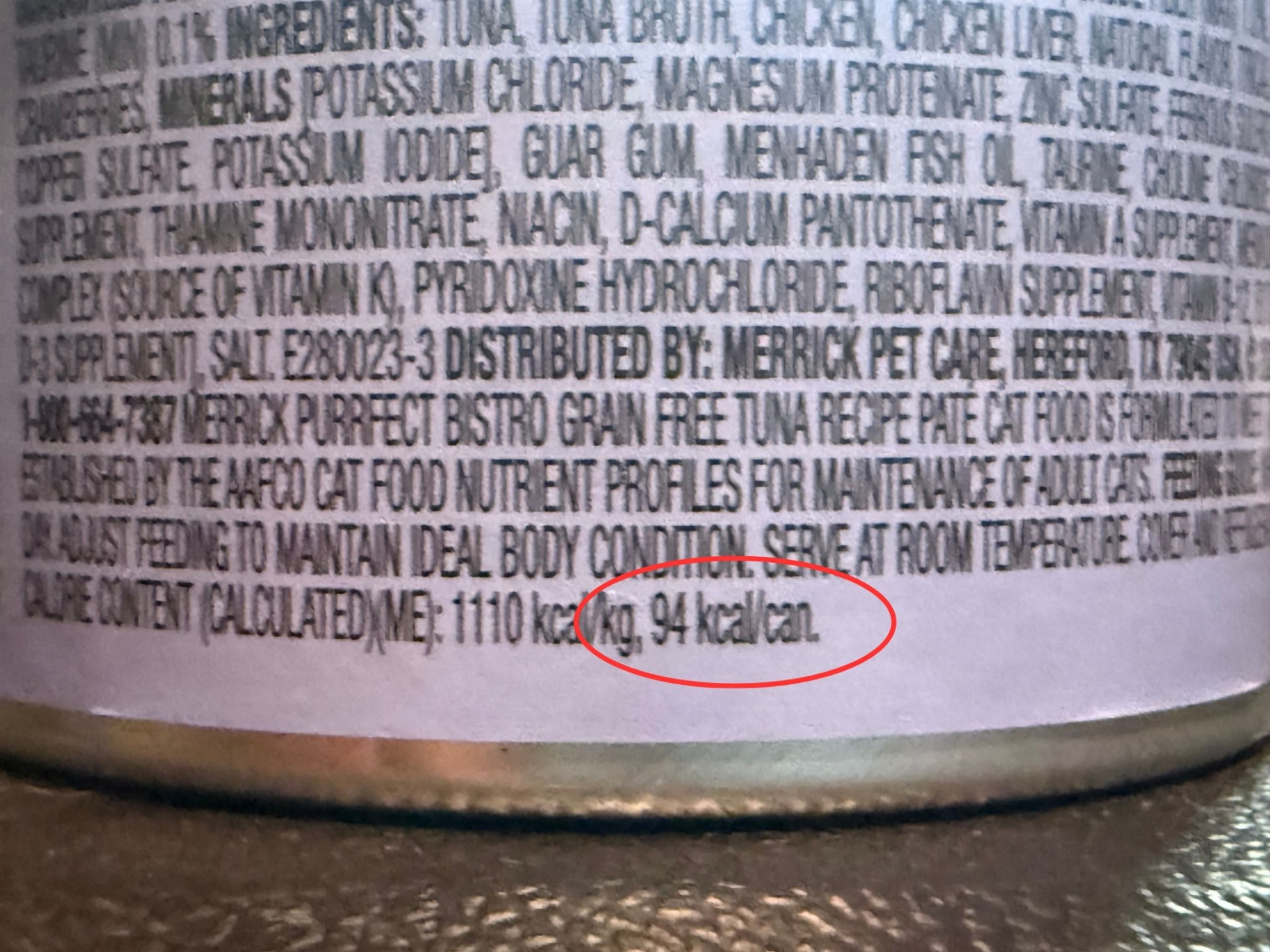
Now the label on your cat's food starts to mean something.
For our first example, we'll use wet food. As you can see in the image above, this particular can contains 94 kcal per can.
Now divide our cat's estimated RER by the calories in each can:
218 ÷ 94 = 2.32 cans
So, roughly 2.3 cans of this particular food would provide about 218 kcal.
Think of this as a starting point rather than an exact prescription. We're using RER as a rough baseline for our example cat. Your cat's actual daily energy needs may be higher or lower depending on their activity level, body condition, age, and other factors.
Keep an eye on your cat's weight and body condition over time and adjust their portions gradually if needed.
If you're unsure about your cat's ideal weight or calorie requirements, your veterinarian can help you determine an appropriate daily amount.
In the example above, we used wet food. Dry food works the same way, but because it is generally more calorie-dense, the portion can look surprisingly small.
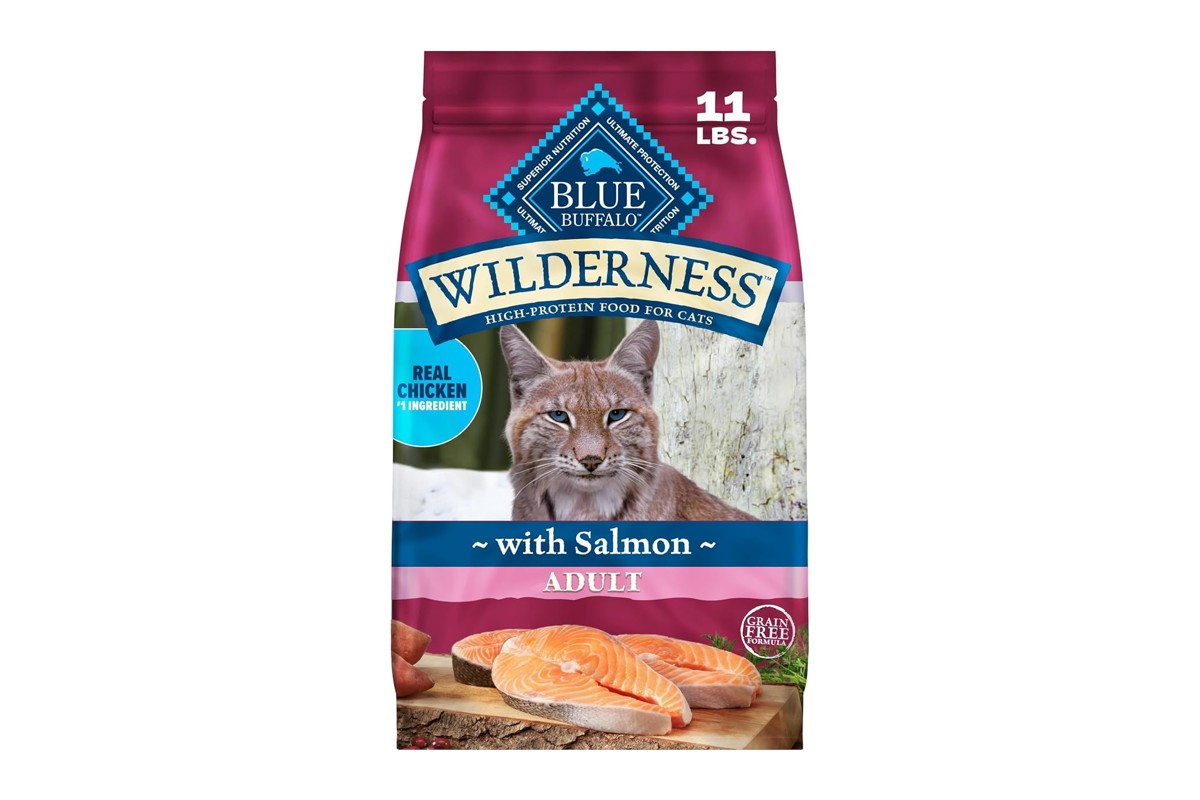
For this example, we're using Blue Buffalo Wilderness Salmon Adult Dry Cat Food, Grain-Freeaffiliate and the same cat as before.
The bag lists the food at 438 Calories per cup.
Our example cat's RER is still approximately 218 kcal per day, so:
218 ÷ 438 = 0.498 cups per day
That's basically ½ cup of dry food per day using this particular food and our RER baseline.
Quick note: On pet-food labels, a capital-C Calorie is equivalent to one kilocalorie (kcal). So 438 Calories per cup is the same as 438 kcal per cup.
With these two example foods, roughly the same number of calories comes from more than two cans of wet food or about half a cup of dry food. That's a good example of just how different portion sizes can look depending on what you're feeding.
If you're measuring dry food by volume, use a standard 1-cup measuring cup. Weighing portions with a kitchen scale can provide even more consistency if the bag also lists its serving weight in grams.
Many cat owners feed a combination of wet and dry food. If you do, the important thing is to count the calories from both foods toward the same daily total.
A common mistake is giving the full daily serving of wet food plus the full daily serving of dry food. Those serving amounts are usually based on each food being fed as the primary diet.
Instead, subtract the calories provided by one food before calculating how much of the other to give.
Using our same example cat, let's stick with the 218 kcal daily baseline.
If one can of wet food contains 94 kcal, then:
218 - 94 = 124 kcal remaining
Our dry food contains 438 kcal per cup, so:
124 ÷ 438 = 0.28 cups
That means one possible daily combination using these particular foods would be roughly:
1 can of wet food + 0.28 cups of dry food
You don't have to use that exact combination. The point is that calories from wet food, dry food, treats, and other extras should all count toward the same daily total.
Now that we know how much to feed your cat in a given day, how should we split that amount into meals?
Some cats do well with two meals per day, while others may benefit from several smaller meals.
Your schedule, your cat's age, and your cat's individual behavior can all influence what works best.
Kittens typically need to eat more frequently than healthy adult cats because they're growing and have different nutritional requirements. Senior cats may also have different needs depending on their health.
Automatic feeders can be useful for dividing dry food into controlled portions and keeping meal times consistent throughout the day. Check out our article, “Should You Get an Automatic Feeder for Your Indoor Cat?” for more info on that.
At the end of the day, figuring out how much to feed your indoor cat doesn't have to mean guessing at the bowl every morning.
Start by estimating their calorie needs, check how many calories are actually in the food you're feeding, and convert that into a measurable portion. From there, keep an eye on your cat's weight and adjust as needed.
The number on the calculator gives you a starting point. Your actual cat tells you whether that starting point is working.
We research, write and update every guide on this site. Our articles are general educational information for cat owners and are reviewed against current guidance from veterinary and feline welfare organisations. Read our editorial policy.
Wet food wins on moisture while dry food wins on convenience. Here's how to choose—or combine them—without losing sight of calories and nutrition.
9 min read
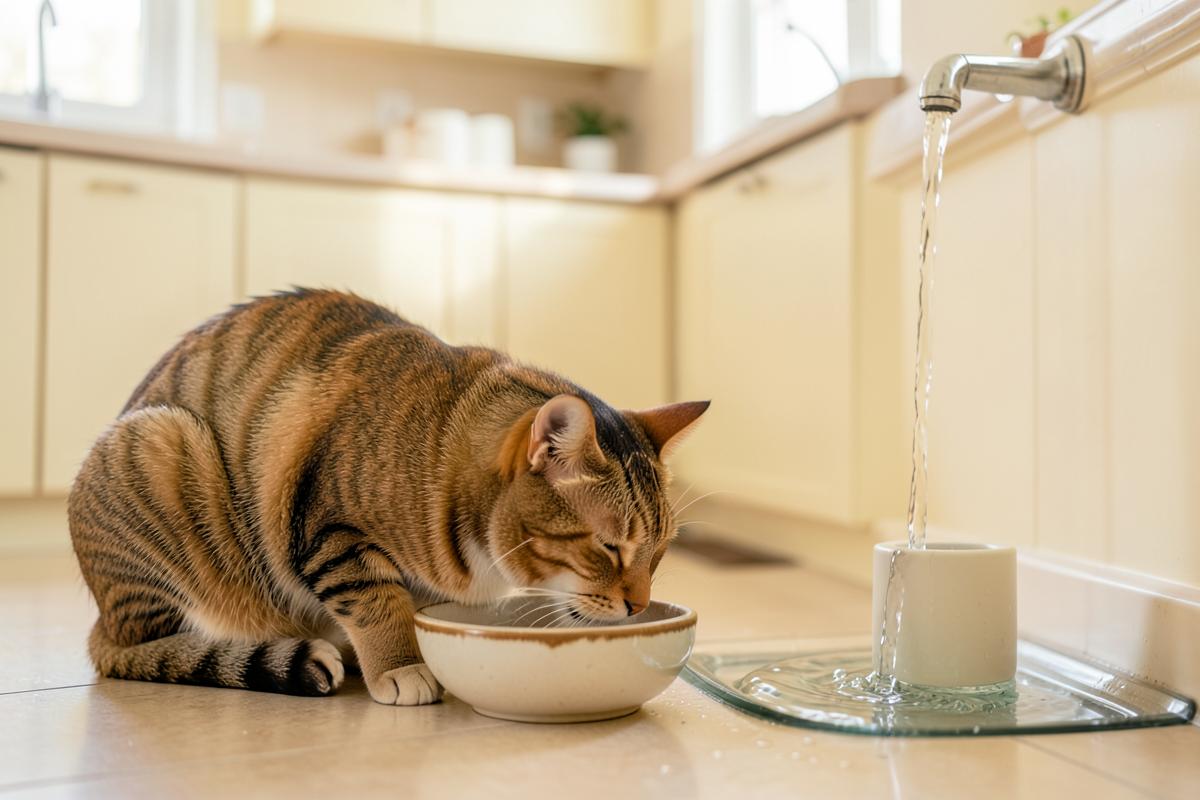
Why cats under-drink, and the placement, bowl and food changes that raise intake without a fight.
6 min read
Why indoor cats gain weight, how to assess body condition at home, and how to lose it slowly and safely with veterinary oversight.
8 min read
A workable daily schedule for meals, play, litter and quiet time — including how to run it around a nine-to-five.
6 min read
Get practical indoor-cat tips, helpful guides, and product recommendations delivered to your inbox.
A short email now and then. Unsubscribe any time.