Interactive toys
Choosing a Wand Toy for an Indoor Cat (Buying Guide)
A wand toy is the one piece of kit that genuinely changes an indoor cat's day. It lets you imitate prey — stalk, chase, pounce, catch — which is the sequence a cat needs to complete to feel settled afterwards.
Affiliate link — as an Amazon Associate we may earn from qualifying purchases, at no extra cost to you. See our affiliate disclosure.
Why we recommend this one
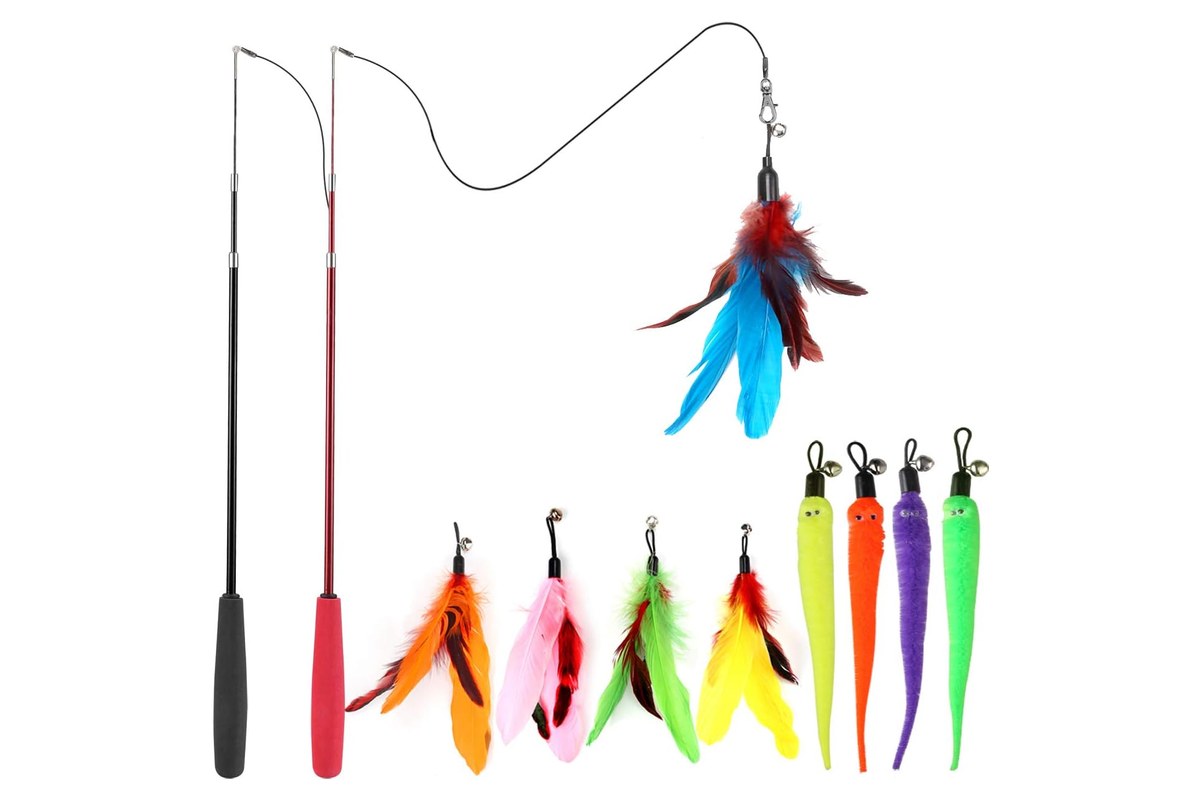
MeoHui Retractable Cat Wand Set (2 wands, 9 refill lures)
Of the wands that meet the checklist below, this is the set we point people to first. It costs less than most single wands, and instead of committing you to one lure it hands you nine — so the cat, not the packaging, decides what it wants to chase.
- Nine lures let the cat pick its own prey
- Feathers, ribbons and fabric tails each move differently, and cats have firm preferences. Working through the refills for a week tells you which one reliably gets your cat off the sofa — information no single-lure wand can give you.
- Refills instead of replacements
- Lures clip on and off, so when a feather is shredded — and it should be, that means the cat is catching it — you swap the lure rather than buy a new toy. Two rods and nine refills outlast a shelf of one-piece wands.
- Retractable rod
- It extends for long, low drags across the floor that keep your hand out of the picture, then collapses to drawer length so the wand can be put away between sessions — which is both the safe way to store string and the reason it stays interesting.
- Cost against function
- It sits at the budget end of the market while including the two things that actually matter, a long reach and interchangeable lures. That balance is why it is an easy first wand to buy and a cheap one to keep restocking.
- Two wands means two people can play
- Handy in a multi-cat home, where one wand tends to be monopolised, and useful as a spare when the first one ends up under the sofa.
What to look for
- A long enough rod
- Around 90 cm of rod plus string keeps your hand out of the picture, so the cat chases the lure rather than you.
- Replaceable lures
- Feathers get destroyed — that is the point. Buy a wand whose lures clip on and off so you are replacing a lure, not the whole toy.
- Strong, thin string
- Thin string moves like a real animal. It should be firmly attached; check the knot every few sessions.
- Varied lure types
- Feathers imitate birds, a fabric tail imitates a mouse. Cats have preferences — a set lets you find your cat's.
What to avoid
- Laser pointers as the only toy — the cat never catches anything.
- Wands with glued-on plastic eyes or beads that can be swallowed.
- Leaving a wand out unsupervised; string is a serious swallowing hazard.
Getting it right at home
- Two sessions of 10–15 minutes a day beats one long one.
- Let the cat catch the lure several times per session, then finish with a meal.
- Store the wand in a drawer between sessions so it stays interesting.
Affiliate link — as an Amazon Associate we may earn from qualifying purchases, at no extra cost to you. See our affiliate disclosure.
Frequently asked questions
- How long should a play session be?
- Ten to fifteen minutes, until the cat is genuinely puffed and slows down. Two sessions a day suits most indoor cats, ideally one in the evening.
- My cat loses interest after a minute.
- Usually the lure is moving wrongly. Drag it away from the cat and let it hide behind furniture rather than waving it overhead — prey flees, it does not hover.
- Is it safe to leave the wand out?
- No. String and feathers are swallowing hazards. Put it away between sessions.
Read next
Other buying guides
Better Cat Care, Delivered
Get practical indoor-cat tips, helpful guides, and product recommendations delivered to your inbox.
A short email now and then. Unsubscribe any time.