Cat Health
Simple At-Home Health Checks for Indoor Cats
A five-minute monthly check that helps you notice change early, plus a plain list of signs that mean booking a vet appointment.
7 min read
I first noticed what looked like tiny grains of rice near my cat’s rear end. Then some of them moved. That changed the question from “What is stuck in the fur?” to “Am I looking at worms?”

Small, rice-like pieces around a cat’s anus, on bedding, or in fresh stool can be tapeworm segments, especially if they wiggle. Fresh segments may move; dried ones can resemble rice grains or sesame seeds. Their appearance is a strong clue, but not every pale speck is a parasite. A veterinarian can help confirm what you found. Cornell Feline Health Center
My experience prompted the research below; it is not a confirmed diagnosis or evidence about anyone else’s cat. The useful next step is to document what you see, contact your vet, and ask about both tapeworm treatment and flea control.
Tapeworms are flat intestinal parasites made up of connected segments. The pieces owners notice are called proglottids: small sections containing eggs that separate from the adult worm.
You are usually seeing a segment, not the entire worm.
Fresh segments can stretch, contract, or crawl. Later, they dry out, shrink, and become seed-like. You might find them caught in fur under the tail, on freshly passed stool, or where your cat sleeps.
The food comparisons are unfortunate but useful. Fresh segments can look like cucumber seeds or moving rice; dried pieces may resemble sesame seeds. Appearance varies with the species and how recently the segment was passed. VCA: Tapeworm Infection in Cats
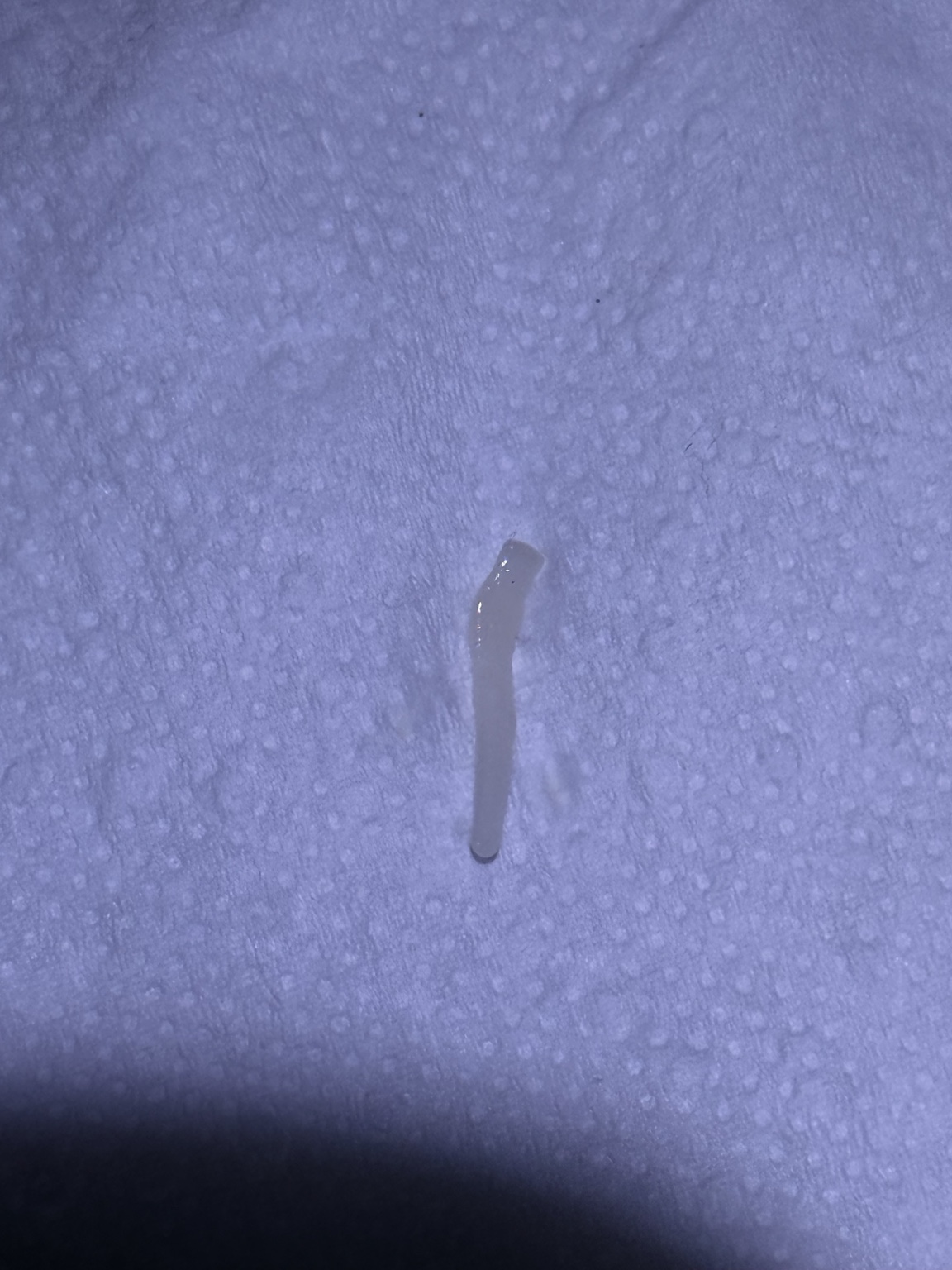
A still photo can miss the most revealing part. If something is moving, a short video may be more useful than trying to describe it over the phone.
No. Litter particles, food debris, and other material can stick to fur. Movement makes a parasite more suspicious, but identification still matters.
Long, spaghetti-like worms suggest a different possibility, such as roundworms. “White worms in cat stool” is a description, not a diagnosis, and the correct treatment depends on the parasite. Merck Veterinary Manual: Gastrointestinal Parasites of Cats
Before cleaning everything away:
A negative routine stool test does not necessarily rule out tapeworms. Eggs may remain inside segments rather than being distributed evenly through the sample. Your observations can therefore matter even if a previous fecal examination was negative. Cornell
That does not make stool testing pointless. A vet may recommend it to investigate other parasites or accompanying symptoms.
One common feline tapeworm, Dipylidium caninum, uses fleas as part of its life cycle.
The sequence is surprisingly specific:
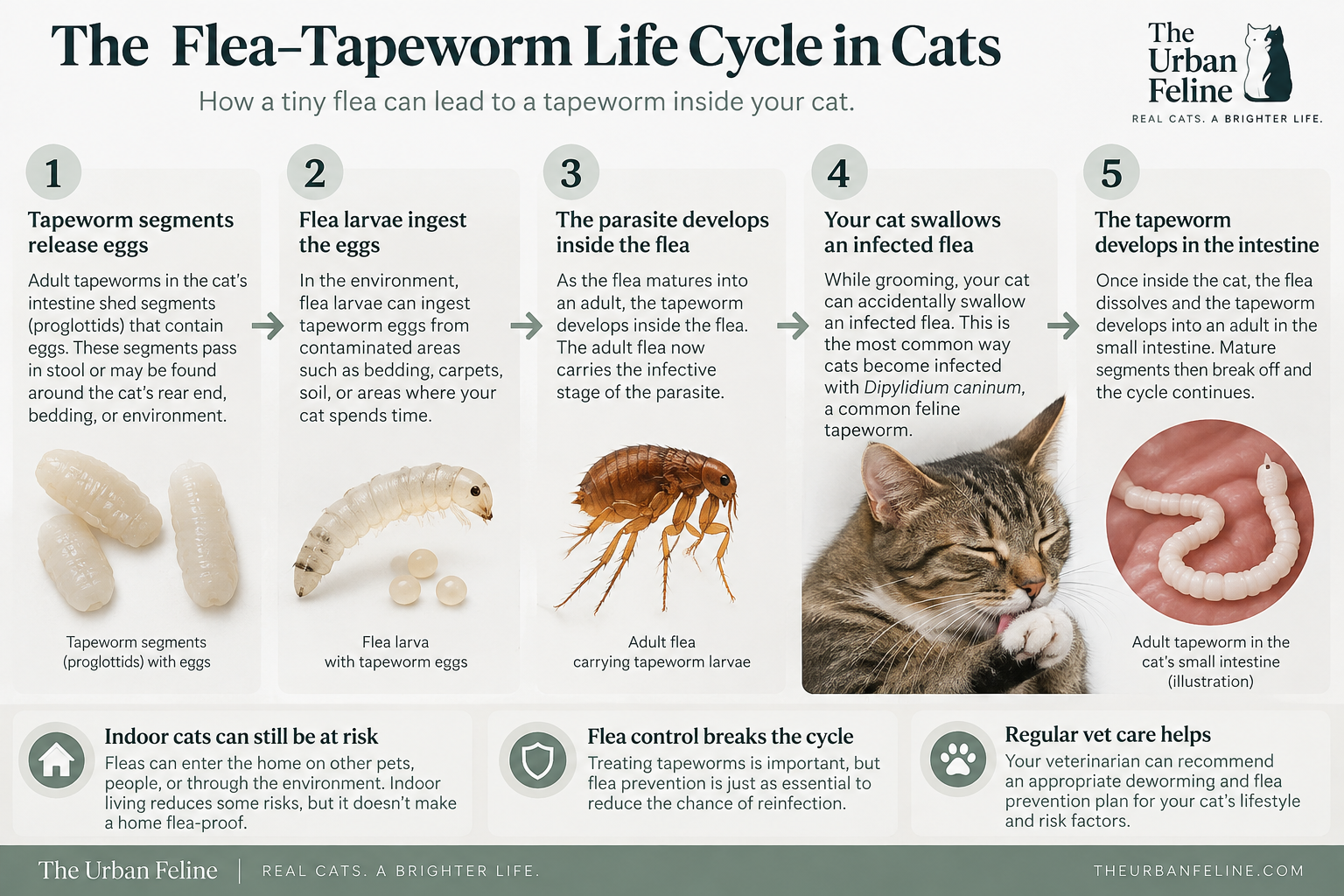
For this species, infection comes from swallowing an infected flea, not simply from being bitten by one. Swallowing loose Dipylidium eggs does not directly infect a cat; the flea is the necessary intermediate host. CDC: Dog or Cat Tapeworm Infection
Other tapeworms have different routes. Cats can acquire some species by eating infected prey, including rodents. Tell your vet if your cat hunts, even if you have never noticed fleas. VCA: Tapeworms in Kittens
This was the distinction that made the situation clearer to me: treating the intestinal parasite and preventing the next infection are related, but separate, jobs.
Yes. Indoor living reduces some exposures, particularly hunting, but does not make a home flea-proof.
Fleas can enter through other animals, and flea life stages can persist in the home. Indoor cats still need a prevention plan suited to their circumstances. PDSA: Flea and Worming Treatment Myths
Not seeing fleas is not proof they were never there. Cats can groom away the evidence. A flea comb can help you check, but a negative combing session does not cancel out suspicious segments. VCA: Flea Control in Cats
Some cats appear completely normal. Visible segments may be the first thing an owner notices.
Possible signs include irritation around the anus, licking, or occasional scooting. Heavy infections can sometimes contribute to weight loss; occasionally, a cat may vomit a worm. Significant illness from tapeworms is uncommon in otherwise healthy cats. VCA: Tapeworm Infection in Cats
Digestive upset, appetite changes, and a poor coat can occur with intestinal parasites, but these signs overlap with many other conditions. A cat that looks unwell needs an assessment rather than an assumption that the rice-like pieces explain everything. Merck Veterinary Manual
Finding segments is a reason to act. On its own, it is usually not a reason to panic.
Praziquantel is commonly used to treat tapeworms in cats. CAPC also identifies epsiprantel as an effective treatment for Dipylidium. The appropriate product depends on the suspected parasite and the individual cat. Companion Animal Parasite Council
Treatments may come in oral, topical, or injectable forms. Ask your veterinarian which formulation is appropriate and follow its instructions. This is particularly important for kittens, pregnant or nursing cats, and cats with other health conditions.
“Dewormer” is a category, not a promise that a product kills every intestinal parasite. Some ingredients target roundworms or hookworms; others cover tapeworms. Combination products have their own specific claims. Merck: Approved Intestinal Worm Treatments for Cats
Do not assume a treatment you already own covers the problem. Check the actual label and ask your vet rather than choosing by packaging or the word “broad-spectrum.”
Avoid combining products, repeating treatment early, or substituting medication intended for another species without veterinary guidance.
After successful treatment, you may never see a whole worm passed. Tapeworms can be broken down inside the intestine. If segments continue or return, contact the clinic instead of repeatedly dosing on your own. VCA
Reinfection is a common explanation, but it is not the only one. CAPC notes occasional apparently treatment-resistant infections, so persistent cases deserve reassessment rather than automatic assumptions. CAPC
Deworming does not remove infected fleas from your cat or home. If your cat swallows another infected flea, the cycle can begin again.
Ask your vet for a coordinated plan covering the affected cat, other household pets, and the environment. Each pet needs a product appropriate for its species, age, and health.
Never put a dog-only flea product on a cat. Some contain permethrin, which is toxic to cats. “A smaller amount” is not a safe workaround. PDSA
Follow application instructions and treatment intervals carefully. Tell your vet about other medications and any previous reactions. The FDA advises contacting a veterinarian promptly if a pet has an adverse reaction to a flea or tick product. FDA: Safe Use of Flea and Tick Products
A flea comb is useful for monitoring. It does not treat the tapeworm inside the intestine.
You need a practical cleaning routine, not a household sterilization project.
For flea control, concentrate on your cat’s sleeping spots and other frequently used areas:
Flea infestations can take time to clear because different life stages are present. Seeing another flea does not mean you should immediately apply another dose. Follow the product schedule and seek advice if control is not improving. CDC: Getting Rid of Fleas
Scoop feces promptly and clean the litter box and pet supplies routinely. Use cleaners as directed, keep animals away during cleaning when required, and follow rinsing and drying instructions. Never mix cleaning products. CDC: Cleaning and Disinfecting Pet Supplies
Removing visible segments keeps things clean, but it cannot substitute for treating the cat and addressing fleas.
Looking for a gentler or cheaper option is understandable. The problem is that an appealing explanation online is not the same as evidence that a remedy clears feline tapeworms.
Veterinary guidance favors products with proven active ingredients. PDSA warns that home remedies are very unlikely to work against worms. PDSA: Worms in Cats
Pumpkin seeds are not an established treatment for tapeworm infection in cats. Research involving a plant compound, another animal species, or a laboratory preparation would not establish that feeding household seeds cures a cat.
I found no authoritative feline treatment guidance supporting them as a replacement for a proven tapeworm medication. Do not delay treatment while waiting for seeds to work.
Do not use garlic to deworm a cat. Garlic can damage red blood cells and cause anemia. Raw, cooked, powdered, and concentrated forms can be hazardous; cats are especially susceptible. Merck: Garlic and Onion Toxicity
If you have already given garlic as a remedy, contact your veterinarian or an animal poison service promptly. Do not wait for obvious symptoms or try to induce vomiting yourself. Cornell: Common Cat Hazards
Apple cider vinegar has no established role in clearing feline tapeworm infections in the veterinary guidance reviewed here. Adding it to food or water is not a substitute for a medication that targets the parasite.
Diatomaceous earth can kill certain insects through a drying action when used under suitable dry conditions. That does not establish that feeding it to a cat treats an intestinal tapeworm.
Its dust can also irritate eyes and airways. “Food grade” does not mean it is a proven dewormer or appropriate to scatter on a cat. National Pesticide Information Center
The word “natural” does not establish safety, effectiveness, or parasite coverage. Show your vet the ingredient list before using a supplement or herbal product. A clear answer about what it treats matters more than a reassuring name.
For Dipylidium, a person becomes infected by accidentally swallowing an infected flea. Petting an infected cat is not the usual transmission route. Human infections are uncommon, and reported cases are most often in children. CDC
Control fleas, dispose of feces, and encourage handwashing, especially before eating and after litter-box cleaning.
This explanation applies to Dipylidium. Other parasites have different transmission routes, so avoid turning it into a blanket claim that all cat worms are harmless to people.
If you notice suspected segments in a person’s stool, contact a healthcare professional. Do not share your cat’s medication.
Contact your vet when you first suspect worms, even if your cat seems well. The clinic can help identify what you found and decide whether an examination, sample, or treatment is appropriate. Kittens warrant particular care because parasites can affect them more severely. PDSA
Request prompt assessment for weight loss, reduced appetite, persistent diarrhea, repeated vomiting, or unusual lethargy. Cornell specifically advises prompt evaluation when vomiting accompanies weakness, decreased appetite, blood, or diarrhea. Cornell: Vomiting
Seek emergency care for collapse, difficulty breathing, pale or white gums, or rapid deterioration. These are not signs to manage as a routine worm problem. VCA: Emergencies in Cats
If it is late at night and your cat otherwise seems normal, document the finding and call your regular clinic when it opens. If you are unsure about symptoms, call an emergency clinic for triage.
Once treatment is arranged, make prevention repeatable:
Treatment schedules should reflect lifestyle and exposure. Indoor-only status is useful information, but it is not a reason to dismiss prevention entirely. VCA: Preventing Parasites in Cats
Moving “rice” deserves attention, but it does not automatically mean your cat is seriously ill.
Photograph what you found, contact your veterinarian, and ask about the right tapeworm treatment and flea control. Skip improvised remedies and avoid assuming any dewormer will do.
What I wish I had understood immediately was simple: identifying the pieces is the first step. Preventing another encounter takes a plan for how the parasite got there.
We research, write and update every guide on this site. Our articles are general educational information for cat owners and are reviewed against current guidance from veterinary and feline welfare organisations. Read our editorial policy.
A five-minute monthly check that helps you notice change early, plus a plain list of signs that mean booking a vet appointment.
7 min read
Scooping frequency, full changes, box numbers and what your cat's litter habits can tell you before anything else does.
6 min read
Get practical indoor-cat tips, helpful guides, and product recommendations delivered to your inbox.
A short email now and then. Unsubscribe any time.